
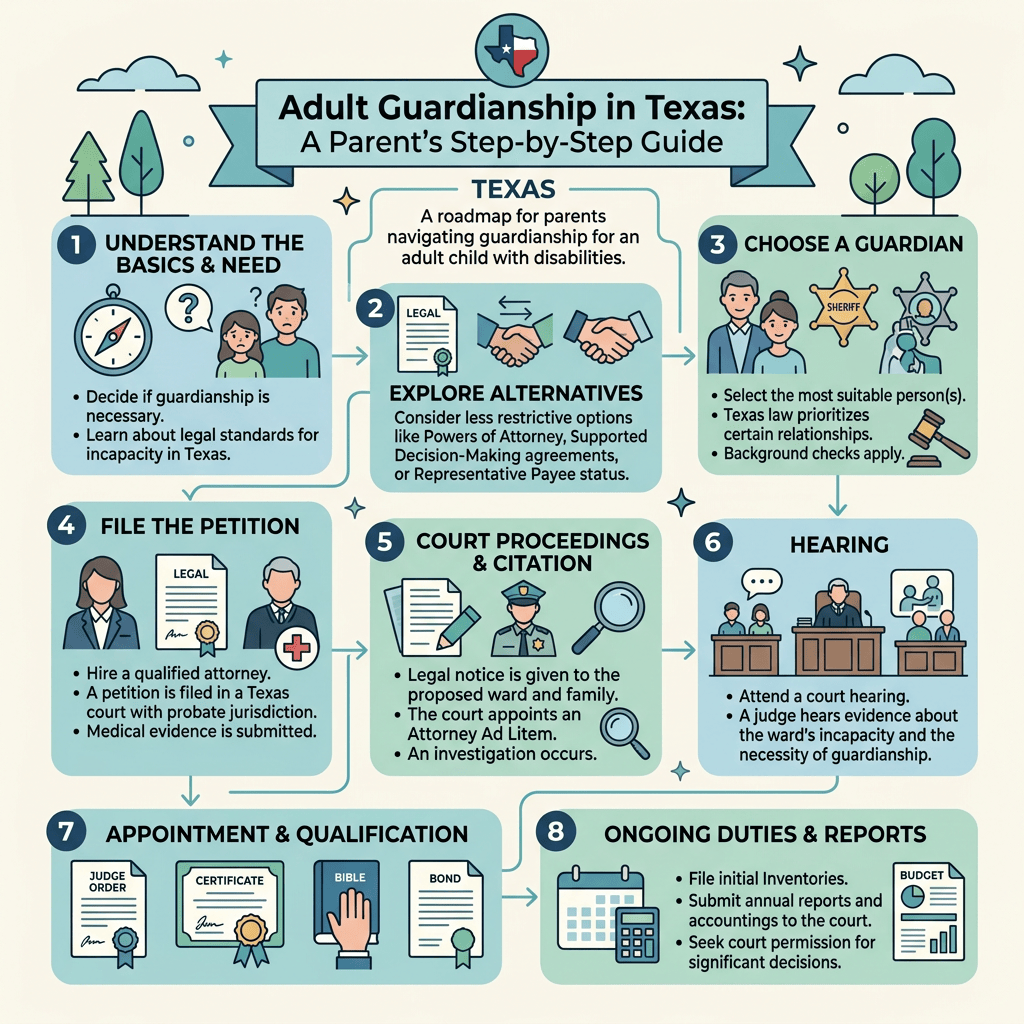
Adult Guardianship in Texas: A Parent’s Step-by-Step Guide
When a child with a disability turns 18, parents often start hearing words like guardianship, court, medical examination, attorney ad litem, background check, training, and annual reports.
It can feel overwhelming.
This guide is meant to give Texas parents a simple place to start.
What Is Guardianship?
Guardianship is a legal process in which a court determines whether an adult needs a guardian to help make certain decisions because the adult is unable to make or communicate those decisions independently.
Guardianship can involve the person, the estate, or both, depending on the circumstances.
It is important to know that guardianship is not automatic when a child turns 18. A parent who wants guardianship must go through the court process.
When Should Parents Start?
You can begin preparing before your child turns 18.
Gather your child’s records, learn about the process, and speak with an attorney or the appropriate probate court clerk about timing.
The actual guardianship case is generally filed in the county where the person who needs a guardian lives. The Texas Judicial Branch specifically directs families to contact the county clerk where the proposed ward resides for information about applying for guardianship.
Step 1: Contact Your County Probate Court/County Clerk
Start by asking:
“I am the parent of an adult child with a disability. I am interested in applying for guardianship of the person and possibly the estate. What is the process in this county?”
The court can tell you which forms, filing requirements, fees, and local procedures apply.
Do not use another county’s forms without checking first. Local procedures can be different.
Step 2: Gather Your Documents
Start creating a folder with:
- Your identification
- Your child’s birth certificate
- Your child’s identification
- Social Security information
- Medicaid information
- SSI information, if applicable
- Medical records
- Psychological or developmental evaluations
- Disability/diagnostic records
- School records and IEP information
- Therapy records
- Medication information
- Information about your child’s daily-care needs
- Information about your child’s assets or income, if you are seeking guardianship of the estate
- Names and addresses of close relatives who may need to receive notice
Your attorney or court clerk can tell you exactly what documents are required for your case.
Step 3: Medical Examination
Texas guardianship cases generally require a Health Care Provider’s Certificate of Medical Examination or the applicable guardianship medical documentation.
The examination helps the court understand the person’s functional limitations and what assistance may be necessary.
Harris County, for example, provides the current guardianship medical-examination and referral forms on its probate court website.
Ask the court or your attorney which current version you should use.
Step 4: File the Guardianship Application
The application is filed with the appropriate probate court/county clerk.
You may want to speak with a Texas guardianship attorney before filing because guardianship is a legal proceeding and the requirements can be complicated.
The Texas Judicial Branch recommends contacting the county clerk where the proposed ward resides for information about applying.
Step 5: Background Check
A proposed guardian generally has to complete a criminal-history background check unless an exemption applies.
The type of background check depends on circumstances such as the value of the proposed ward’s liquid estate and whether the proposed guardian lives in Texas.
Step 6: Guardianship Training
Most proposed guardians must complete the Texas guardianship training module.
After completing it, you receive a certificate. The certificate must be provided to the court and uploaded as part of the guardianship registration process.
Certain people, including Texas attorneys, Texas certified guardians, and some others listed by the Judicial Branch, are exempt.
Step 7: Court Hearing
The court will schedule a hearing.
The judge will review the case and determine whether guardianship is appropriate and what type and extent of guardianship is needed.
You may also have an Attorney Ad Litem involved in the case to represent the interests of the proposed ward.
The exact hearing procedure depends on your county and court.
Step 8: If You Are Appointed Guardian
If the court appoints you, there are additional responsibilities.
Depending on the type of guardianship, you may have responsibilities involving:
- Medical and personal decisions
- Living arrangements
- Benefits
- Financial matters
- Property
- Annual reports
- Accounting requirements
A guardian of the person and a guardian of the estate have different responsibilities.
Make sure you understand exactly what the court order gives you authority to do.
What About the JBCC?
The Judicial Branch Certification Commission (JBCC) handles guardianship registration.
After filing the guardianship with the county, the proposed guardian completes the required registration process with the JBCC. Texas currently requires guardianship registration to be submitted through its online system. Registration itself is free.
JBCC Guardianship Registration
Phone: 512-463-1656
Alternative: 512-475-4368, Extension 2
Email: registeraguardianship@txcourts.gov
For background-check questions:
Email: jbccbackgroundspecialist@txcourts.gov
The JBCC advises that email is the best way to contact the registration department.
What Forms Should Parents Look For?
Some of the important documents/forms you may encounter include:
Guardianship Application
Starts the court case.
Health Care Provider’s Certificate of Medical Examination
Provides medical information to the court about the proposed ward’s condition and functional abilities.
Suggestion of Need for a Guardian
Used in the guardianship process to notify the court that guardianship may be needed.
JBCC Guardianship Registration
Registers the guardianship with the Judicial Branch Certification Commission after the court process begins.
Guardianship Training Certificate
Proof that the required training has been completed.
Background Check Documentation
Required for proposed guardians unless an applicable exemption applies.
Annual Report
Guardians of the person generally have ongoing reporting responsibilities. The exact requirements depend on the type of guardianship and court orders.
If You Are in Harris County
For families in Harris County, guardianship matters are handled through the Harris County Probate Courts.
Harris County Civil Courthouse
201 Caroline
Houston, TX 77002
Probate Court 5
1115 Congress St., 5th Floor
Houston, TX 77002
The Harris County Probate Courts provide guardianship checklists, medical-examination forms, registration information, training information, annual-report information, and other resources online.
Harris County Probate Clerk: 713-274-8588
Because Harris County has several probate courts, contact the clerk before going in person to confirm where and how your particular case should be filed.
Important: You May Not Need a Full Guardianship
Every adult with a disability has individual circumstances.
Before pursuing guardianship, ask an attorney whether a limited guardianship or less restrictive alternative could meet your adult child’s needs.
The goal is to make sure your adult child has the appropriate legal support while preserving as many rights and choices as possible.
What Should Parents Do Before Their Child Turns 18?
Start early.
Create a folder.
Gather medical and school records.
Make a list of your child’s daily needs.
Find out which court handles guardianship in your county.
Ask about the medical examination.
Ask about attorney requirements.
Ask about filing fees.
Learn about the JBCC registration and training requirements.
And consider speaking with a Texas attorney who regularly handles special-needs planning and guardianship.
A Simple Checklist
Before you begin, make a folder containing:
☐ Parent’s ID
☐ Child’s ID/birth certificate
☐ Medicaid information
☐ SSI information
☐ Medical records
☐ Disability evaluations
☐ Psychological evaluations
☐ IEP/school records
☐ Therapy records
☐ Medication information
☐ List of daily-care needs
☐ Financial/asset information if estate guardianship may be needed
☐ Names and addresses of required relatives/parties
☐ Medical examination information
☐ Court forms
☐ JBCC training certificate
☐ Background-check information
Most Important Advice
Don’t wait until the day your child turns 18 to start learning about this.
Start preparing early.
Ask questions.
Keep copies of everything.
And remember that guardianship is a court process, so the exact requirements can depend on your county and your child’s individual circumstances.
For more resources for Texas families raising children with disabilities, visit HirahCares.org.
This guide is for general educational purposes and is not legal advice. Guardianship can affect important legal rights. Families should confirm the current requirements with their county probate court and consider consulting a qualified Texas guardianship/special-needs attorney.
 Hirahcares